
Deck Staining Cost in Ladue: The Six Things That Move Your Number
Deck staining cost is one of the widest ranges in exterior work, and the reason is not the stain. Two Ladue decks of the same size can sit a long way apart on price, and almost all of that gap is prep.
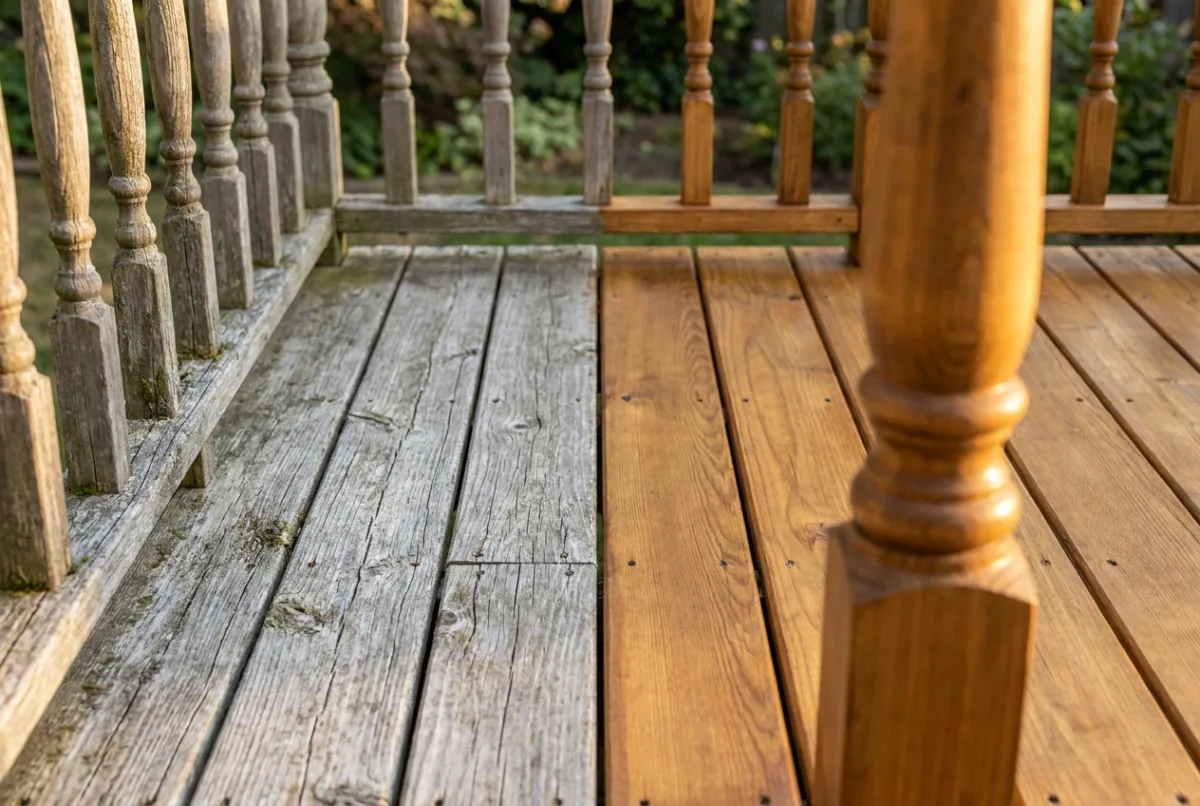
What National Cost Guides Can Tell You About Deck Staining Costs
As a reference point before you collect quotes: national cost guides publish per-square-foot ranges for deck staining labor and for all-in cost, labor plus materials. They are national aggregates, not a price for any specific deck.
Published ranges are wide, and that spread is not noise — it is prep. The same square footage sits at the bottom of a range when the existing finish is sound, and at the top when it has to be stripped, neutralized and sanded before anything new goes on.
Why Deck Staining Cost Varies So Much for the Same Square Footage
Stain is the smallest cost in a stain job. What sets the price is everything that has to happen before a single coat goes on: stripping a failing finish, sanding raised grain, resetting fasteners, replacing a board, and getting the wood dry enough to accept the product.
A deck stained two years ago with a compatible product that has faded evenly is a wash, dry and coat. A deck with a peeling film finish over gray weathered wood is a strip, neutralize, sand and coat — several times the labor for the same footprint.
The Six Things That Move Your Deck Staining Cost
Measured surface sets the baseline, and it is more than the floor. Railings, balusters, stair stringers and a lattice skirt all have to be coated, and balusters are the slowest surface on any deck.
The current finish is second, and it is the big one. Stripping a failed solid or film-forming stain is a fundamentally different job from refreshing a penetrating oil that has simply faded.
Wood condition is third. Cupped or splintered boards need sanding, popped fasteners need setting, and a soft board needs replacing before it gets coated. Coating over a bad board only hides it for a season.
Product choice is fourth. A transparent stain, a semi-transparent, a semi-solid and a solid-color finish cost differently and last differently, and the right one depends partly on what is already on the wood.
Access is fifth. A ground-level deck is straightforward. An elevated deck over a slope, with the substructure visible from the yard, means more setup and a second set of surfaces.
The weather window is sixth, and it is the one nobody plans for. Stain needs dry wood and a dry stretch afterward. In a St. Louis spring that genuinely constrains scheduling, and a job that has to be staged around rain costs more to run.
Doing It Yourself Versus Hiring It Out
Staining a deck is genuinely doable, and for a small, well-maintained ground-level deck it is often the right call. The material is not the hard part.
The prep is the hard part, and it is where most homeowner jobs go wrong. Stain applied over a surface that was not fully stripped, or over wood that was still wet inside, fails early and unevenly — and the next cycle then starts from a worse place than the first one did.
The honest test is the current finish. If it is fading, it is a weekend project. If it is peeling, the job is a strip job, and strip jobs are where hiring earns its money.
Where Wood Deck Staining Ends and Patio Restoration Begins
A lot of Ladue decks sit next to a flagstone, brick or paver surface, and the two get quoted together. They are different work — wood is stripped and coated, masonry is cleaned and sometimes sealed — but handled on one mobilization they cost less than two separate visits.
What Is Actually Covered
Before any work starts, ask the provider for current insurance documentation and confirm who will be on your property — their own crew or subcontractors.
A good quote is written against a defined scope: measured surface, the prep level found, the product and the number of coats. If the deck opens up worse than it looked — a soft board under a rug, a failed section of railing — ask for the revised number before the work is done.
If you want a real figure rather than a national per-square-foot average, you need a quote from a provider who has seen the deck. The condition of the existing finish is the big factor in your number, and that takes a look in person.
Frequently Asked Questions
- How much does deck staining cost in Ladue?
- Your own number is set by measured surface including railings and balusters, the condition of the existing finish, whether boards need sanding or replacing, the product, and access. National cost guides publish per-square-foot ranges, but they are national aggregates, not a price for your deck; a quote from a provider who has seen the deck is the number to rely on.
- Why does stripping an old stain add so much to the price?
- Because it is a separate job before the job. A failed film finish has to be broken down, removed, neutralized and often sanded before any new stain will bond. That can be more labor than the staining itself.
- Should I stain my own deck?
- For a small ground-level deck with a finish that is fading rather than peeling, it is a reasonable weekend project. If the existing finish is peeling, the work is a strip job, and that is where most homeowner attempts fail early.
- Do I need to be home for a wood deck staining visit?
- Not always. Exterior work usually needs only access to the deck and, if needed, an exterior water connection, so ask the provider whether the visit can be completed without you present.
Ready to get started? Contact Ladue Power Wash.